E-ink is reporting that they'll meet projections for ereaders in 2011.
I found this bit interesting:
But global shipments of e-book readers experienced a seasonal dip in the second-quarter, according to IDC. Shipments reached nearly six million units in first-quarter 2011, but shipments in the second quarter totaled 5.4 million units, up 167% on-year but down 9.2% on-quarter.
Amazon Kindle's market share slid to 51.7% in the second-quarter from about 53% in the first, while Barnes & Noble's Nook dropped to 21.2% from about 23%, according to IDC.
Amazon is barely holding onto half the market. Since they are the most 'indie-friendly' ebookstore, that is bad on one hand... on the other, it is good not to have a market dominance.
I blogged before don't count on keeping the market lead. For example, For the last 3 months in the US Android cell phones have outsold iPhones two to one. I'm surprised to see B&N and Kindle both lost market share. I'm wondering who gained? (Google? Apple? With Boarders going kaput, I doubt it was Kobo and Microsoft dropped their initiative.)
Got Popcorn?
Neil
Ps
This doesn't include tablets.
The above sales figures show that ereaders sell ok in the 1st and 2nd quarters but are really a back to school and holiday phenomenon. 1H2011 11.4Million out of 25 to 30 million (e-ink). I suspect we'll see another 5 million LCD ereaders in 2011. So the 2nd half of the year is about 2/3rds of the sales. Hence why Amazon is waiting on their new ereaders, tablet, and B&N the rumored new Nook tablet right before the holidays.
I'm big into cell phones as 'convenience readers.' We recently returned from a cruise and for every reader on a Kindle, I saw one on a smartphone, one on a tablet (almost all iPads, a few Samsungs, but not many), and three to five playing games on their cellphones or tablets. :( And for each Kindle reader two reading pbooks. :) Mind you, it was a Disney cruise, so lots of waiting in line. ;)
So only somewhat related, Microsoft's phone strategy baffles me. February is too late for Nokia. B&N showed how it should be done. The nook color October 2010, Nook simple-touch in
updated 12:40pm
Monday, September 26, 2011

Friday, September 9, 2011
June 2011 Ebook sales
June was not a pretty month for print sales. I've read before that Borders represented close to half of paperback sales and judging from the cliff-fall in Adult paperback, that was indeed the case. Total print trade sales are down $120 million per month from the prior year trend. With AAP ebook sales only at $80 million, we're talking about an 11% drop in gross revenues for June.
Now, I expect this is hit of the Borders failure and shutdown. The question is, will there be a rebound after the Borders inventory has been liquidated?
I did expect Ebook sales to be slightly better in June. If Ebook sales had truly followed the 2011 growth curve, they would have been $83 million versus $80 million. Is that significant? Since more than a few indie authors report a drought and blamed the 'Sunshine Deals,' which favored AAP publishers, I suspect the real reason was we finally broke the crappy winter weather and people went out and played. Then again, growth has been so tremendous in 2011, we can take a breather.
But you come here for the charts, so here they are.
Overall, ebook growth is still faster than the 2010 growth trend by quite the margin!

I'm resurrecting an old chart format. This is by year ebook sales with 'events' that I believe helped shape AAP ebook sales. I'm rather surprised that the 'Sunshine Deals' didn't spike up sales further.

I've noted before that ebooks jump in market share at the start of the year. We seem to be holding to the pattern but a different month to month variation over prior years:

Edit: I had bad links in the excel sheet on this chart. Mea culpa and corrected 2:30pm 9/11/2011
I've started a new chart: A comparison of how that month's sales did versus the nominal for the last few years, 2010, and a trend. Print books are slowing quickly. 80% of the prior year's sales except for kids books which are doing much better. Ebooks have fast growth and while I commented about June, graphically it looks like it is just maintaining 2011 growth with a little noise. Edit: Don't get excited about MMPB doing a little better than prediction; my once favorite format is in decline. June is MMPB's 'month to shine.' So it did better than falling off a cliff, but not by much. :(

Trade print was very weak. Adult paperback and MMPB and thrashing print sales. More on that later.

Adult hardcover was OK. The weak side of OK, but ok.

Adult paperback fell off a cliff. Nothing seasonal about this drop. It is the changes in the industry that are happening. The question is, will any other bookstore step into Borders space of selling high volumes of paperbacks?

My pre-ebook favorite form factor was MMPB. MMPB is on life support. It cannot survive at these low sales.

It makes me happy to see how well kids books are doing. :)

Seasonal Charts:
I like the bar chart to emphasize how strong, versus prior years, ebooks are doing. :)

I'll go out of order in the seasonal charts and show just how nicely childrens books are selling. :)

Again, hardcover is OK, but weak:

One didn't have to plot a seasonal chart to see that paperback books fell off a cliff.

I usually comment on how poorly MMPB is doing, but adult paperback made this category look 'better than usual.' But MMPB is weak and is pulling down trade print sales.

Overall, June was a weak month for books sales. While ebooks did well, the wholesale side of the business took a hit due to the Boarders bankruptcy to the tune of about an 11% cut in revenue. I wonder if there will be a snap back after the liquidation (which is still going on in September)? Or is this just a setup to selling ereaders and tablets?
Got Popcorn?
Neil
Now, I expect this is hit of the Borders failure and shutdown. The question is, will there be a rebound after the Borders inventory has been liquidated?
I did expect Ebook sales to be slightly better in June. If Ebook sales had truly followed the 2011 growth curve, they would have been $83 million versus $80 million. Is that significant? Since more than a few indie authors report a drought and blamed the 'Sunshine Deals,' which favored AAP publishers, I suspect the real reason was we finally broke the crappy winter weather and people went out and played. Then again, growth has been so tremendous in 2011, we can take a breather.
But you come here for the charts, so here they are.
Overall, ebook growth is still faster than the 2010 growth trend by quite the margin!

I'm resurrecting an old chart format. This is by year ebook sales with 'events' that I believe helped shape AAP ebook sales. I'm rather surprised that the 'Sunshine Deals' didn't spike up sales further.

I've noted before that ebooks jump in market share at the start of the year. We seem to be holding to the pattern but a different month to month variation over prior years:

Edit: I had bad links in the excel sheet on this chart. Mea culpa and corrected 2:30pm 9/11/2011
I've started a new chart: A comparison of how that month's sales did versus the nominal for the last few years, 2010, and a trend. Print books are slowing quickly. 80% of the prior year's sales except for kids books which are doing much better. Ebooks have fast growth and while I commented about June, graphically it looks like it is just maintaining 2011 growth with a little noise. Edit: Don't get excited about MMPB doing a little better than prediction; my once favorite format is in decline. June is MMPB's 'month to shine.' So it did better than falling off a cliff, but not by much. :(
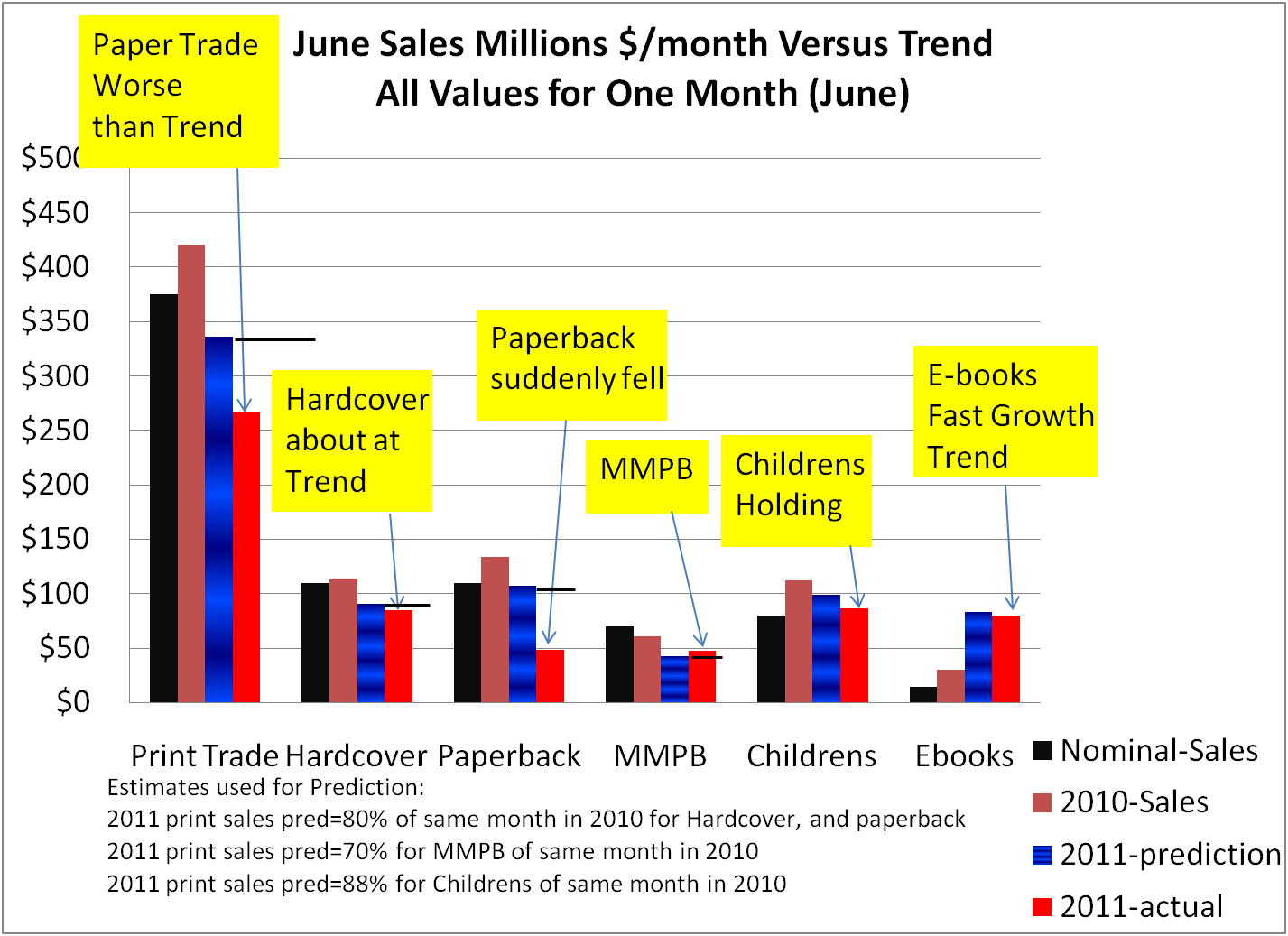
Trade print was very weak. Adult paperback and MMPB and thrashing print sales. More on that later.

Adult hardcover was OK. The weak side of OK, but ok.

Adult paperback fell off a cliff. Nothing seasonal about this drop. It is the changes in the industry that are happening. The question is, will any other bookstore step into Borders space of selling high volumes of paperbacks?

My pre-ebook favorite form factor was MMPB. MMPB is on life support. It cannot survive at these low sales.

It makes me happy to see how well kids books are doing. :)

Seasonal Charts:
I like the bar chart to emphasize how strong, versus prior years, ebooks are doing. :)

I'll go out of order in the seasonal charts and show just how nicely childrens books are selling. :)

Again, hardcover is OK, but weak:

One didn't have to plot a seasonal chart to see that paperback books fell off a cliff.

I usually comment on how poorly MMPB is doing, but adult paperback made this category look 'better than usual.' But MMPB is weak and is pulling down trade print sales.

Overall, June was a weak month for books sales. While ebooks did well, the wholesale side of the business took a hit due to the Boarders bankruptcy to the tune of about an 11% cut in revenue. I wonder if there will be a snap back after the liquidation (which is still going on in September)? Or is this just a setup to selling ereaders and tablets?
Got Popcorn?
Neil
Monday, August 22, 2011
Where are the AAP sales numbers?
Where are the AAP numbers? I see the Bookstats. David has already shown how out of date those numbers are. But Robin shows were in a seasonal lull in ebook adoption.
So I ask, where are the numbers? They should be releasing the nice 'Sunshine' deal from Amazon (June) numbers right now. I speculate that between the Borders debacle and Amazon's sale, the numbers make print look worse than the long term trend.
If you look at Robin's article, we should expect another holiday shift. The interesting bit is that since this is now international (US, UK, Germany for Amazon and soon India), this will provide many opportunities for sales in the future.
But where are the AAP numbers? Hope is not a strategy...
Neil
ps
Anyone else think the numbers will be even more convoluted than last month's release (see last link).
8/31/2011 update:
Random House doing well in digital.
"Digital sales across all RH companies for the first half of 2011 have already exceeded their total for all of 2010, Dohle noted. In the U.S., digital sales accounted for over 20% of revenue, and RH has more than 27,000 titles available in e-book formats worldwide. "
There is more worth reading in the above link. I think Random House has been wise in its aggressive move to digital. But they are only doing average for the AAP publishers in ebook market share (See last month's sales numbers and market share
So I ask, where are the numbers? They should be releasing the nice 'Sunshine' deal from Amazon (June) numbers right now. I speculate that between the Borders debacle and Amazon's sale, the numbers make print look worse than the long term trend.
If you look at Robin's article, we should expect another holiday shift. The interesting bit is that since this is now international (US, UK, Germany for Amazon and soon India), this will provide many opportunities for sales in the future.
But where are the AAP numbers? Hope is not a strategy...
Neil
ps
Anyone else think the numbers will be even more convoluted than last month's release (see last link).
8/31/2011 update:
Random House doing well in digital.
"Digital sales across all RH companies for the first half of 2011 have already exceeded their total for all of 2010, Dohle noted. In the U.S., digital sales accounted for over 20% of revenue, and RH has more than 27,000 titles available in e-book formats worldwide. "
There is more worth reading in the above link. I think Random House has been wise in its aggressive move to digital. But they are only doing average for the AAP publishers in ebook market share (See last month's sales numbers and market share
Thursday, August 18, 2011
Can ebook growth keep Accelerating?
E-ink expects to ship 27 million screens in 2011. This has helped 2011 ebook sales be about 280% of 2010. On triple the ereader sales plus 'other reading devices.' Think about that ratio a minute.
2.8/(3X+1X)=70%
On average in 2011 ereader owners are buying 70% of the books per ereader as 2010 ereader owners. This is better than I expected! It means 2010 ereader buyers are still buying despite a 'too be read pile.' It also means that while, on average, new 2010 ereader buyers are not spending as much (at least on AAP books), they are not slackers in ebook buying either. So can we see further ebook buying acceleration in 2012?
Let me define acceleration. I do not mean that sales just increase, but that the *rate* of sales increase is greater than the prior year. Please look at this chart I put on on May ebook sales:

Let's estimate ebook sales in 2012 off prior years. (Use the red lines as a guide.)
If we estimate off AAP ebook sales in 2010: $100 million per month in 2012.
Off AAP sales in 2011: $150 million per month in 2012
Off my estimate of total ebook sales in 2011: $200 million per month in 2012!
So acceleration of sales means ebook sales faster than $200 million per month in 2012. :) Can that happen?
First criteria is devices to read on. E-ink has two factories now. One of the two factories is new, so it isn't up to speed. I can only do a 'thumb in the wind estimate,' but I would guess e-ink could slightly more than double e-ink screens in 2012. Perhaps 2.5X the screens of 2011. So e-ink alone could accelerate sales!
But there is also Mirasol from Qualcomm.
http://www.mirasoldisplays.com/
A new factory with new screen capabilities. So we could see 3X the ereaders in 2012 that we see in 2011.
The next need is the ratio of ebook sales to ereader sales. I expected that to drop far more than it has in 2010. 70% as many dollars of ebooks per ereader is great. I would have guessed 50% to 75% is a really optimistic turn out. A tripling of ereader sales plus the prior year sales to generate 200% to 300% of the ebook sales. I'm happy with 280%, but at some point 'less intense readers' will be the normal ereader buyer.
Low end is in 2012 double the ereader sales with a ratio of 50% is (2X+1X)*50%=150%. Or about $150million/month a year from now. So the low end is no acceleration in ebook sales, but no decline. If this happens, expect peak ebook sales to be 60% to 65% of the market (noted by the lack of ebook sales acceleration). I do not expect this scenario.
High end is a tripling of ereader sales again with a ratio of about 65%. (The ratio will always go down.) or (3x+1x)*65%=260% or ~$250million/month (realize we're working with approximate numbers here). Under this scenario ebooks will break 90% of the book market quickly. A little too ambitious in my opinion.
So either ereader sales will drop from the tripling of sales per year or the ratio will drop. We can bracket 2012 ereader sales at 2X to 3X 2011 ereader sales. We can bracket the ratio of ebook dollars per ereader (ignoring ereaders from prior years, assuming they get replaced) at 50% to 65%.
We can also know that both will not be at either their high or low extremes. What will they be? It is anyone's guess.
What I do know is that about a year from now I can tell you the approximate ebook market share in 2017. (Technical diffusion follows a pattern.)
With Amazon discounting the K3 to $114, I expect a K4 soon and in either September or October the 'Kindle tablet.' B&N just received a lifeline that I expect to be invested in further Nook devices. Apple, Kobo, Sony, and Google will all remain active in the market too.
2012 Will be an exciting year for ebooks.
Got Popcorn?
Neil
Ps
First color e-ink go on sale in September. Note: WSJ might be subscription.
2.8/(3X+1X)=70%
On average in 2011 ereader owners are buying 70% of the books per ereader as 2010 ereader owners. This is better than I expected! It means 2010 ereader buyers are still buying despite a 'too be read pile.' It also means that while, on average, new 2010 ereader buyers are not spending as much (at least on AAP books), they are not slackers in ebook buying either. So can we see further ebook buying acceleration in 2012?
Let me define acceleration. I do not mean that sales just increase, but that the *rate* of sales increase is greater than the prior year. Please look at this chart I put on on May ebook sales:

Let's estimate ebook sales in 2012 off prior years. (Use the red lines as a guide.)
If we estimate off AAP ebook sales in 2010: $100 million per month in 2012.
Off AAP sales in 2011: $150 million per month in 2012
Off my estimate of total ebook sales in 2011: $200 million per month in 2012!
So acceleration of sales means ebook sales faster than $200 million per month in 2012. :) Can that happen?
First criteria is devices to read on. E-ink has two factories now. One of the two factories is new, so it isn't up to speed. I can only do a 'thumb in the wind estimate,' but I would guess e-ink could slightly more than double e-ink screens in 2012. Perhaps 2.5X the screens of 2011. So e-ink alone could accelerate sales!
But there is also Mirasol from Qualcomm.
http://www.mirasoldisplays.com/
A new factory with new screen capabilities. So we could see 3X the ereaders in 2012 that we see in 2011.
The next need is the ratio of ebook sales to ereader sales. I expected that to drop far more than it has in 2010. 70% as many dollars of ebooks per ereader is great. I would have guessed 50% to 75% is a really optimistic turn out. A tripling of ereader sales plus the prior year sales to generate 200% to 300% of the ebook sales. I'm happy with 280%, but at some point 'less intense readers' will be the normal ereader buyer.
Low end is in 2012 double the ereader sales with a ratio of 50% is (2X+1X)*50%=150%. Or about $150million/month a year from now. So the low end is no acceleration in ebook sales, but no decline. If this happens, expect peak ebook sales to be 60% to 65% of the market (noted by the lack of ebook sales acceleration). I do not expect this scenario.
High end is a tripling of ereader sales again with a ratio of about 65%. (The ratio will always go down.) or (3x+1x)*65%=260% or ~$250million/month (realize we're working with approximate numbers here). Under this scenario ebooks will break 90% of the book market quickly. A little too ambitious in my opinion.
So either ereader sales will drop from the tripling of sales per year or the ratio will drop. We can bracket 2012 ereader sales at 2X to 3X 2011 ereader sales. We can bracket the ratio of ebook dollars per ereader (ignoring ereaders from prior years, assuming they get replaced) at 50% to 65%.
We can also know that both will not be at either their high or low extremes. What will they be? It is anyone's guess.
What I do know is that about a year from now I can tell you the approximate ebook market share in 2017. (Technical diffusion follows a pattern.)
With Amazon discounting the K3 to $114, I expect a K4 soon and in either September or October the 'Kindle tablet.' B&N just received a lifeline that I expect to be invested in further Nook devices. Apple, Kobo, Sony, and Google will all remain active in the market too.
2012 Will be an exciting year for ebooks.
Got Popcorn?
Neil
Ps
First color e-ink go on sale in September. Note: WSJ might be subscription.
Sunday, August 14, 2011
Ode to the IBM 5150
My parents had a TRS-80
Then mom needed an IBM 5150
Then in college, I borrowed Mac (friends or the universities)
In grad school I bought a 'clone PC' or utilized Sun workstations.
That clone PC went through two hard drives, three motherboards, two monitors, and three video cards. But like an axe where you replace the handle or the head, it was the same. :) Then I went through a pair of laptops. Both of which have helped me buy ebooks.
The 5150 was huge. Without 'the PC,' I doubt computers would be where they are today. It took someone to jump start the industry. It wasn't the first computer nor the last; but it launched an industry. Much like the Amazon Kindle. ;)
My point? Lead, follow, or get out of the way. IBM didn't control any of the software and that pushed them out of the business. Amazon, Apple, Nook (B&N), and Kobo all control the keys to their media. So I wonder if this generation of technology wouldn't be a bit more resistant?
I give the advantage to Amazon. As with the 5150, those were bought because they were a safe bet. With Amazon, their software (ebooks) will run on any platform/OS that will let them. I know of more than a few people who have bought Kindles as it was:
1. Cheap (like the 5150 vs. other business computers)
2. Portable software (5150 to Compaq, Kindle to an app)
3. Market leader (there is a group that feels safe in the pack)
You might be going, why advantage to Amazon? I know of a few who didn't buy Ipads due to 'being locked into the ecosystem.' Amazon isn't doing a 'hard lock.' More of a 'convenience lock' which customers are happy with. For example, there is a reason Netflix is so popular; you don't have to buy their device.
We owe much to the 5150. Without it, there wouldn't be e-readers (in my opinion). 30 years of PCs. It seems like more.
Neil
Then mom needed an IBM 5150
Then in college, I borrowed Mac (friends or the universities)
In grad school I bought a 'clone PC' or utilized Sun workstations.
That clone PC went through two hard drives, three motherboards, two monitors, and three video cards. But like an axe where you replace the handle or the head, it was the same. :) Then I went through a pair of laptops. Both of which have helped me buy ebooks.
The 5150 was huge. Without 'the PC,' I doubt computers would be where they are today. It took someone to jump start the industry. It wasn't the first computer nor the last; but it launched an industry. Much like the Amazon Kindle. ;)
My point? Lead, follow, or get out of the way. IBM didn't control any of the software and that pushed them out of the business. Amazon, Apple, Nook (B&N), and Kobo all control the keys to their media. So I wonder if this generation of technology wouldn't be a bit more resistant?
I give the advantage to Amazon. As with the 5150, those were bought because they were a safe bet. With Amazon, their software (ebooks) will run on any platform/OS that will let them. I know of more than a few people who have bought Kindles as it was:
1. Cheap (like the 5150 vs. other business computers)
2. Portable software (5150 to Compaq, Kindle to an app)
3. Market leader (there is a group that feels safe in the pack)
You might be going, why advantage to Amazon? I know of a few who didn't buy Ipads due to 'being locked into the ecosystem.' Amazon isn't doing a 'hard lock.' More of a 'convenience lock' which customers are happy with. For example, there is a reason Netflix is so popular; you don't have to buy their device.
We owe much to the 5150. Without it, there wouldn't be e-readers (in my opinion). 30 years of PCs. It seems like more.
Neil
Monday, August 8, 2011
How ereaders will become cheaper
We discuss the sub $100 ereader in the comment section of various blogs, but the question should be "how can anyone sell a cheap ereader?"
1. Economy of scale. E-ink inc. is increasing shipments
25million to 30million ereaders plus the Nook color and other device reading! Plus a new factory coming online...
2. Touch screens are the most costly component for many of the devices. Two finger and other low cost touchscreen solutions will be popular with ereaders.
3. Frame costs among other components A $5 savings might not sound like much, but it adds up.
4. Weak chip sales estimates for 3q2011 should reduce the build costs. Next year it will be the new 28nm chip manufacturing process.
5. Software profits (e.g., for Amazon, B&N, and Apple) Do I really need a link for my typical audience? In the long run the profit will be in the media, not the device. Thus vendors will cut profits.
6. Size. I wonder why no vendor has come out with a fractionally smaller e-reader? There is nothing magical about 6" or 7" screens. Oh, 3.5" is too small (too many page turns), but some middle ground would sell.
7. Cell Phones. Sales of these are exploding. Why isn't there an ereader cellphone subsidized by the carriers? Seriously, we've already had the 3G e-readers for $189. Increase the battery size a little and the ereader could be a free cellphone with data plan on any US cellphone network.
In conclusion:
I keep reusing this link. One item to note again and again is the 'elastic market' of ereaders. Look at the bottom of page 22. Currently over 53% of the potential ereader buyers are 'priced out' of the market. Note: That isn't the only growth; there is a huge market considering ereaders who remain on the fence. Ideas like Amazon's offers will further cut the price.
Ereaders are an elastic market. While some of us want higher end devices, there needs to be a gateway drug.
Got Popcorn?
Neil
1. Economy of scale. E-ink inc. is increasing shipments
25million to 30million ereaders plus the Nook color and other device reading! Plus a new factory coming online...
2. Touch screens are the most costly component for many of the devices. Two finger and other low cost touchscreen solutions will be popular with ereaders.
3. Frame costs among other components A $5 savings might not sound like much, but it adds up.
4. Weak chip sales estimates for 3q2011 should reduce the build costs. Next year it will be the new 28nm chip manufacturing process.
5. Software profits (e.g., for Amazon, B&N, and Apple) Do I really need a link for my typical audience? In the long run the profit will be in the media, not the device. Thus vendors will cut profits.
6. Size. I wonder why no vendor has come out with a fractionally smaller e-reader? There is nothing magical about 6" or 7" screens. Oh, 3.5" is too small (too many page turns), but some middle ground would sell.
7. Cell Phones. Sales of these are exploding. Why isn't there an ereader cellphone subsidized by the carriers? Seriously, we've already had the 3G e-readers for $189. Increase the battery size a little and the ereader could be a free cellphone with data plan on any US cellphone network.
In conclusion:
I keep reusing this link. One item to note again and again is the 'elastic market' of ereaders. Look at the bottom of page 22. Currently over 53% of the potential ereader buyers are 'priced out' of the market. Note: That isn't the only growth; there is a huge market considering ereaders who remain on the fence. Ideas like Amazon's offers will further cut the price.
Ereaders are an elastic market. While some of us want higher end devices, there needs to be a gateway drug.
Got Popcorn?
Neil
Thursday, August 4, 2011
What fraction of the successful authors is Amazon Signing?
Huffington post notes how indie authors are using their success to go to publishing.
"It is for this group especially that e-books are so important, as they have essentially become a "gateway drug," enabling successful indie authors to stroll down the path into the welcoming arms of traditional publishers."
But thankfully I had just read David Gaughran's latest post. So I was thinking Amazon's latest imprint. When I recognize the cover it struck me to look who the listed authors had signed with:
Of the five examples, #1, #3, and #5 were 'was sold to Amazon's Thomas & Mercer'
Read the article on David's blog. Here is what struck me. Indie authors seem to respect "Joe Konrath has explained the power of an Amazon marketing push, something they don’t restrict to new titles, unlike most publishers." Yes, pbooks are marketing. Authors want simple contracts without 'non-compete clauses.' If they're going to risk pbooks, they want marketing.
My concern with Thomas & Mercer was their ability to put books into stores. With the quantity of best selling authors signed, the concern is 'can bookstores afford to not stock their titles?'
Got Popcorn?
Neil
"It is for this group especially that e-books are so important, as they have essentially become a "gateway drug," enabling successful indie authors to stroll down the path into the welcoming arms of traditional publishers."
But thankfully I had just read David Gaughran's latest post. So I was thinking Amazon's latest imprint. When I recognize the cover it struck me to look who the listed authors had signed with:
Of the five examples, #1, #3, and #5 were 'was sold to Amazon's Thomas & Mercer'
Read the article on David's blog. Here is what struck me. Indie authors seem to respect "Joe Konrath has explained the power of an Amazon marketing push, something they don’t restrict to new titles, unlike most publishers." Yes, pbooks are marketing. Authors want simple contracts without 'non-compete clauses.' If they're going to risk pbooks, they want marketing.
My concern with Thomas & Mercer was their ability to put books into stores. With the quantity of best selling authors signed, the concern is 'can bookstores afford to not stock their titles?'
Got Popcorn?
Neil
Subscribe to:
Posts (Atom)